- Plain Sight Productions
- Posts
- Full Circle I
Full Circle I
Christology > biology

Mr. PSP
April 10, 2026
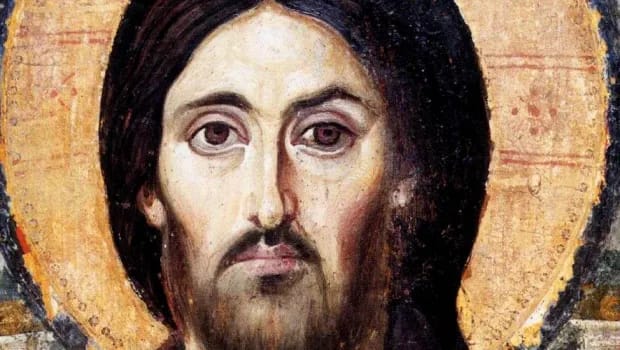
mercy | justice
Soteriology through Christology.
A somewhat opaque phrase that seems to obscure a simple truth behind technical jargon is the key to understanding the Christian faith at its deepest level.
When studying soteriology—how we are saved—ancient Christianity teaches that it cannot be grasped without using the lens of Christology. Of course, all Christian traditions must necessarily view soteriology through Christology to some extent, as the common agreement of Christ’s salvific work redeeming mankind must include the person of Christ. However, because many Christian traditions do not utilize the “soteriology through Christology” method in the same way it has been historically understood, the result is, unsurprisingly, misconceptions about how exactly one is saved.
More specifically, many Christian sects begin first with the question of “How are we saved?” first, and only later attempt to hash out the intricate details of the wills, personhood, and nature of Christ when in fact the latter must precede the former. This is because a deep understanding of Christ will naturally answer the soteriology question.
To do so, we must first analyze Christ’s mission.
Nearly all Christians understand that He came to simultaneously fulfill the role of the royal Davidic messiah and suffering servant, unlock the gates of heaven, fulfill the Old Covenant laws, and more.
However, one underappreciated aspect of His mission was the necessity to sanctify the human flesh.
The Church has historically taught that Christ was baptized not only to display His full humanity but also to sanctify the waters of baptism so that His grace would flow to us through the sacrament, leaving an indelible mark on the soul.
In the same way Christ sanctified the baptismal water through His contact with it, He also sanctifies the human flesh through the Incarnation.
Thus, this simple fact provides the catalyst for the dichotomy we’ve seen develop between apostolic and non-apostolic forms of Christianity.
From the general Protestant perspective, Christ of course bore our iniquities and provided salvation as a free gift; however, there is a key distinction. Justification is viewed as more of a legal decree of righteousness rather than an intrinsic transformation of the soul through participation in the sacraments. The cause for this error is the precedence soteriology takes over Christology, as many Reformers concluded that because humans are unbelievably wicked due to the fall of Adam, it is clear that the justification discussed ubiquitously by St. Paul refers to the unworthy merely being labeled as worthy. For after all, how could such depraved beings ever be considered truly righteous in the eyes of the God that is goodness itself?
On the flip side, from the Catholic perspective, this conjoining of the divine and human natures in the person of Christ means that, through baptism and other sacraments, we are sanctified in a tangible way, as we receive the grace that allows us to actually cooperate with God. Many, either in bad faith or in ignorance, of course attack Catholicism’s assertion that cooperation with God’s grace is necessary for salvation as a “works-based salvation,” when this is simply not the case. Faith in Your Work covers the faith-works relationship in depth, highlighting the idea of being saved by grace through faith working in love, as without Christ being the first mover and bestowing this grace, the loving cooperation with His will is impossible.
“If any one saith, that man may be justified before God by his own works, whether done through the teaching of human nature, or that of the law, without the grace of God through Jesus Christ; let him be anathema.”
“If any one saith, that by faith alone the impious is justified; in such wise as to mean, that nothing else is required to co-operate in order to the obtaining the grace of Justification, and that it is not in any way necessary, that he be prepared and disposed by the movement of his own will; let him be anathema.”
Thus, Christ’s Incarnation is not just the instrument of our salvation, but more specifically, the instrument of our sanctification, through which we are saved.
In other words, Christ came down to bring us up.
More specifically, He came not just to bring us up to heaven but to bring us up to approach the sanctity that He displayed during His time here on Earth.
“The Word of God, our Lord Jesus Christ, did, through His transcendent love, become what we are, that He might bring us to be what He is Himself.”
“Through these, he has bestowed on us the precious and very great promises, so that through them you may come to share in the divine nature, after escaping from the corruption that is in the world because of evil desire.”
Studying Christology not only answers the question of how we are saved but also provides keen insight into the question of God’s sovereignty versus our free will.
The Church has consistently taught that humans have free will, as we can know this because denying free will as an attribute of human nature completely collapses our understanding of salvation history. For, if humans don’t have free will, this means that Christ did not willingly choose to die out of love for us because Christ’s human will could not have actually consented to the divine will. Thus, if this were the case, it would not only be the divine essence obeying Itself but it would also distort the sanctity of the sacrifice, as Christ’s humanity willingly taking on such a gruesome death adequately atones for the sin of the original man.
Also, Christ’s humanity is not merely something acted upon by the divine essence but rather is an actor in and of itself, as wills naturally correspond to natures, thus providing the distinction of Christ’s human and divine will. We see this clearly in the Crucifixion scene, in which Christ’s human will submits to the divine will:
“Father, if you are willing, take this cup away from me; still, not my will but yours be done.”
Thus, while many naturally tend towards a zero-sum framework in which humans either have free will or God’s sovereignty is impenetrable, we know both can be true at the same time through the willing submission of Christ’s human will and the divine decree of the salvation of mankind through the unblemished sacrifice occurring.
The last theological subsection we understand more fully as we study Christ deeper is the eventual bodily resurrection of every individual.
In addition to the Church’s historical teaching of bodies reuniting with the soul after the second coming of Christ, we can also deduce this eventual reunion through the person of Christ, as when Christ returns to His apostles, one of the first items on His agenda is to convince them that He is not merely a spiritual entity but rather reappears with the same body He traversed the Earth with:
While they were still speaking about this, he stood in their midst and said to them, “Peace be with you.” But they were startled and terrified and thought that they were seeing a ghost. Then he said to them, “Why are you troubled? And why do questions arise in your hearts? Look at my hands and my feet, that it is I myself. Touch me and see, because a ghost does not have flesh and bones as you can see I have.” And as he said this, he showed them his hands and his feet. While they were still incredulous for joy and were amazed, he asked them, “Have you anything here to eat?” They gave him a piece of baked fish; he took it and ate it in front of them.
“Thomas, called Didymus, one of the Twelve, was not with them when Jesus came. So the other disciples said to him, “We have seen the Lord.” But he said to them, “Unless I see the mark of the nails in his hands and put my finger into the nailmarks and put my hand into his side, I will not believe.” Now a week later his disciples were again inside and Thomas was with them. Jesus came, although the doors were locked, and stood in their midst and said, “Peace be with you.” Then he said to Thomas, “Put your finger here and see my hands, and bring your hand and put it into my side, and do not be unbelieving, but believe.” Thomas answered and said to him, “My Lord and my God!” Jesus said to him, “Have you come to believe because you have seen me? Blessed are those who have not seen and have believed.”
Because we see Christ resurrect and ascend with His original body, we can conclude that this same fate must also be in store for us as well.
The main reason why this reunion will eventually occur is simple: humans are a body-soul composite, so it would be unreasonable for only one part of the whole to experience the highest good known to man.
Let’s zoom out a bit.
Adam and Eve were created with original justice, in which their senses were subjugated by their will and intellect, and their will and intellect were perfectly ordered towards God. Moreover, they were created by God and for God in the sense that their purpose was to experience the glory of God in both body and soul. However, after the fall, the ordering of their passions being completely subjugated by their will and intellect became corrupted and thus, sin, death, concupiscence, and the rest entered into the world, providing a chasm between God and humans. This meant that until justice on behalf of the human race was established through a perfect and eternal sacrifice, humans could not be in the direct presence of God, neither in body nor soul. The only problem was that any sacrifice from a mere human—even if it meant laying one’s life down—could not satisfy the justice required, especially if the sacrifice were to cover humans from the beginning into all eternity. Thus, whoever was to offer this sacrifice needed to be both human yet infinite in nature.
The first coming of the God-Man is the answer to this seemingly impossible task.
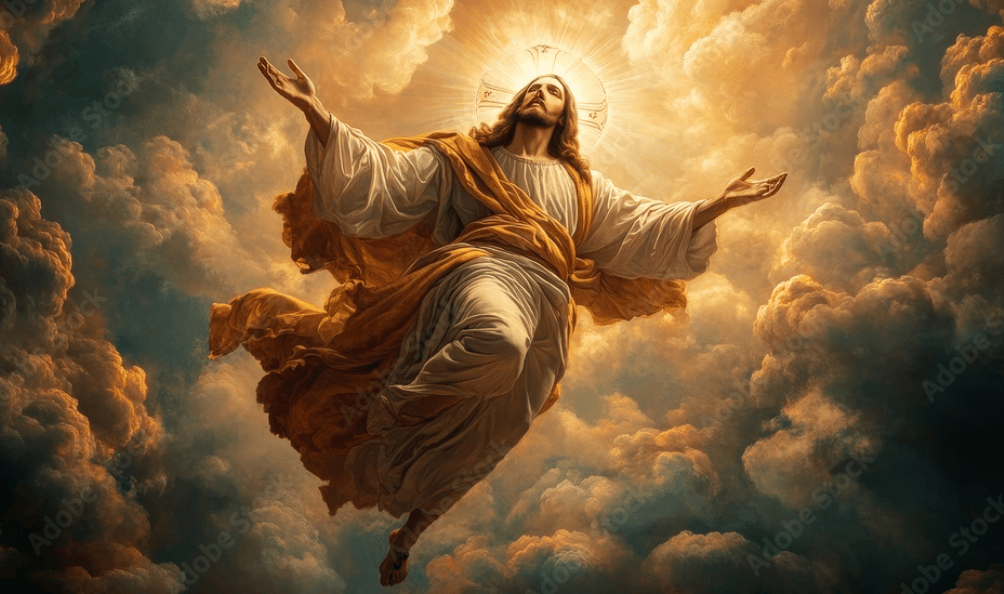
infinite aura.
After His death, resurrection, and ascension into heaven, souls were now permitted to the heavenly banquet.
Through His death, Christ defeats death.
Through His resurrection, Christ opens the gates of heaven.
Through His ascension, Christ leads the souls of the Church triumphant—His body—as the head through the gates of heaven.
But the story does not end there.
After the second coming of Christ when evil is defeated for good, both body and soul will be able to enjoy the splendor of seeing the divine essence face to face. Moreover, the glory will be heightened after the reunion, as the those who experience heaven with their glorified body will feel the glory of God with an increased magnitude relative to only the soul’s vision of God. Not only this, but those who rejected God during their life will also be reunited with their body and experience the pains of hell in an increased magnitude as well.
Among the aforementioned reasons, the reunification of body and soul intuitively checks out because of the dependence on our body during this present life that, of course, determines our state in the afterlife. Thus, it would be illogical for the body to have no role in the afterlife and would vindicate the Gnostic belief of the purity of the immaterial soul and the corrupt nature of the material body.
This hope for the resurrection of the body is precisely why the Church has historically discouraged cremation. Purposefully contradicting a core Christian doctrine, pagans notoriously cremated the dead, denying the possibility that any sort of reunification would occur. Of course, cremation does not hinder an individual’s soul to be reunited with their body but rather is an act that can symbolically reject this hope.
The key question thus becomes when exactly this reunification will occur.
The answer is after Christ’s second coming.
There is always much chatter surrounding this awaited second coming, and “the Rapture” always seems to appear in this discourse. What strangely does not appear in this discourse is the restoration of the Earth through the creation of “a new heaven and Earth.”
Mysterious to say the least.
To be continued.
If you enjoyed this article, feel free to share with your family, co-workers, and friends and tell them to subscribe.
Thanks for reading and until next time.
Reply