- Plain Sight Productions
- Posts
- Hearts & Minds
Hearts & Minds
who says the two can't work together?

Mr. PSP
January 30, 2026

Liberalism is a lie.
Among the many incorrect doctrines it promulgates, its chief falsehood is the idea of egalitarianism.
This is not referencing the idea that we are created equally in the eyes of God or should be treated equally under the law.
Rather, the egalitarianism liberalism preaches denies the reality that both individuals and groups are not equal but rather different, leading to the natural hierarchies that develop over time due to discrepancies in skills and competencies. Thus, when groups exhibit vastly different outcomes, the liberal world order cries foul and assumes discrimination must have been present in some manner.
But those who know the truth understand hierarchies naturally develop on both a macro and micro scale.
When it comes to the hierarchy of theologians of the Church, there are many who deserve notoriety.
Saint Augustine, the grace doctor.
Saint Athanasius, the ardent Trinity defender against heretics.
More recently, St. John Henry Newman, the 19th century Anglican convert.
Among many more.
But among the greats, there is an undisputed great: St. Thomas Aquinas.
He was born as the youngest child of nine in 1225 in Naples, Italy to a very influential noble family. He studied in the famous monastery of Monte Cassino at the young age of five, where it became clear that the boy’s intellect was special.
By 16, he was enrolled in the University of Naples, studying liberal arts, long before this legendary line of study was corrupted.
The high caliber education he was receiving placed him perfectly in line with his family’s expectation: to become the Abbot of Monte Cassino, a powerful post that held religious, but more importantly, political prestige.
After all, it only made sense to groom the precocious boy for a position of influence, given his family’s role as vassals to the Holy Roman emperor. They also lived right between imperial and papal lands, and during this time period, influential families essentially had to pick between loyalty to the emperor or to the Pope.
The context must be understood to grasp the importance of Aquinas’s future decisions.
It hadn’t always been the case that people needed to choose between loyalty to the Pope or the emperor. After all, the two had historically worked together, starting with the notorious crowning of Charlemagne as “King of the Romans” by Pope Leo III in 800. Yes, the Western Roman Empire had been defunct for more than three centuries, but it is a common tactic for leaders to revive empires of old as a way to solidify the legitimacy of their rule in a tactic known as translatio imperii (transfer of rule). The basic partnership involved the emperor reigning supreme in temporal affairs and the Pope reigning supreme in spiritual and moral affairs. Thus, the political and spiritual stability of the empire was ensured through the duo playing their respective roles.
But things get tricky when the lines get blurred.

only room for one.
On one hand, the emperor believed that he ruled through divine appointment according to Sacred Scripture, thus holding the right as the political ruler of Christendom to reign supreme when it became unclear who to defer to.
“Let every person be subject to the governing authorities. For there is no authority except from God, and those that exist have been established by God. Therefore, whoever resists authority resists what God has appointed, and those who resist will incur judgment.”
On the other hand, the Pope acknowledges that there are aspects of temporal leadership that should solely belong to the emperor, but as the spiritual leader of Christendom, he alone has the spiritual authority bestowed to Peter from Christ. Furthermore, this authority is more important than the temporal because the soul is of greater importance than the body theologically, thus requiring submission of the king to the Pope in moral and religious matters.
“Jesus said to him in reply, ‘Blessed are you, Simon son of Jonah. For flesh and blood has not revealed this to you, but my heavenly Father.
And so I say to you, you are Peter, and upon this rock I will build my church, and the gates of the netherworld shall not prevail against it.
I will give you the keys to the kingdom of heaven. Whatever you bind on earth shall be bound in heaven; and whatever you loose on earth shall be loosed in heaven.’”
However, it doesn’t take a genius to realize that a leader ruling essentially all of Western and Central Europe will likely have a hard time submitting to another man.
Specific questions of who would appoint bishops, control Church lands, summon councils, oversee clergy, and more needed to be answered.
While it seems like the obvious answer is the Pope in these scenarios, it wasn’t always cut and dry given the dual roles that many bishops and priests held in the medieval times.
Bishops were often landowners, judges, tax collectors, and sometimes even military lords, thus taking on roles that bled into the temporal domain.
Tensions peaked in the 11th century, as Pope Gregory VII prohibited lay investiture—the appointment of bishops—to prevent the emperor from exercising, in his view, a clearly religious role. The emperor, Henry IV, was not a fan of the new rule and continued to do so anyways, leading to his excommunication.
Henry IV immediately attempted to seek forgiveness and make amends with the Pope, as he understood the political inexpedience that excommunication creates, presenting a real threat to his reign.
Because of this, he famously traversed to the Pope’s gate of the Canossa Castle and waited outside and fasted for three days before being let in. After prostrating before the Pope and asking for forgiveness, his excommunication was lifted.
But the truce didn’t last long, as a group of German bishops loyal to the emperor conspired to depose Gregory VII, and Henry IV, seizing on the opportunity, appointed an antipope Clement III. The real pope, Gregory VII, was locked in a castle, watching an imposter rule the throne that rightly belonged to him.
Gregory would eventually make his way back after Norman troops rescued him, sacking Rome while they were at it. Unfortunately, the sacking of the city was somehow blamed on him, and he was thus forced to flee and die in exile because he “loved justice and hated iniquity.”
After this, the relationship between the Pope and the emperor remained rocky.
In Aquinas’ age, it was more of the same with Pope Gregory IX disapproving of several moves from Frederick II like repeatedly delaying the sixth crusade he promised to lead, infamously negotiating with the Muslims while being excommunicated, and crowning himself King of Jerusalem.
With this in mind, Aquinas was on track to become another political ally to the emperor to inevitably seize power away from the Pope. Thus, when he eventually chose to forego this path and join the Dominican order, it was essentially a betrayal not only on behalf of his family, but on behalf of the emperor.
Being a Dominican was the worst possible scenario from the family’s vantage point, as it meant being poor, politically useless, and aligned with the Pope.
As a response, his family locked him in their castle for a year and would only release him after he changed his mind.
According to several accounts, his family went so far in discouraging him from the monastic life that they sent a prostitute to his dungeon as an attempt to break his vows.
Aquinas then famously grabbed a burning log and chased her out of the building.

real men hate lust. #based
After seeing the devotion Aquinas had to the religious life, his mother helped him escape, and he began his journey as a priest, theologian, and teacher. He began to study under another respected theologian of the Church, Albertus Magnus, known as St. Albert the Great.
Aquinas touched upon every facet of theology, but his main focus was devoted towards reconciling faith and reason. While many philosophers have historically pitted the two against each other, Aquinas believed that they go hand-in-hand rather than contradicting each other.
He identifies three errors when analyzing the relationship between faith and reason, with the first being skepticism, or the idea that faith in and of itself is contrary to reason and thus must be ignored when attempting to make sense of the world. The next is fideism, the idea that we must not use our reason and must solely rely on faith to determine what is true and what isn’t. Both of these concepts agree that faith and reason are antithetical to one another and we should thus choose one and abandon the other. The last is subjectivism that claims that the truths of faith are personal and are dependent on the minds of individuals.
Aquinas rejects all three and claims that faith and reason must be complementary due to the unity of truth. More specifically, we know that the truth revealed to us through Sacred Scripture and Tradition must align with the truth we can deduce from reason because God is the source of both. Reason cannot possibly be contradictory to faith because the only reason we have an intellect is because God allowed us to share in His intellectual nature in a way that no other being does. How then could this intellect be incapable of working together with the faith He has also bestowed on us?
Because of this unity of truth, Aquinas posits that it is impossible for anything to be true according to faith and false according to reason.
Our Christian faith is unique in that it is the most reasonable religion through the many motives of credibility like its endurance, miracles of Christ, and fulfillment of prophecy, while also containing doctrines that cannot be deduced from reason alone, like the Trinity. Most importantly, none of these tenets are opposed to reason.
This reconciliation between faith and reason is detailed in his works like Summa Contra Gentiles, On Being and Essence, and Against the Errors of the Greeks, but none have the notoriety that his magnum opus Summa Theologica holds.
In his works, St. Thomas is also well known for detailing the particulars of transubstantiation. He did not create the term, as it had been in circulation for at least a century prior to him and was even used in the Fourth Lateran Council that took place ten years before he was born.
However, he was the first to systematize it and present a philosophically coherent explanation as to how the mystery is possible using Aristotelian metaphysics. He would oftentimes place his head on the blessed tabernacle, trying to unite his mind with the body of Christ so that he could eloquently describe to the world how exactly the Lord makes this miracle possible.
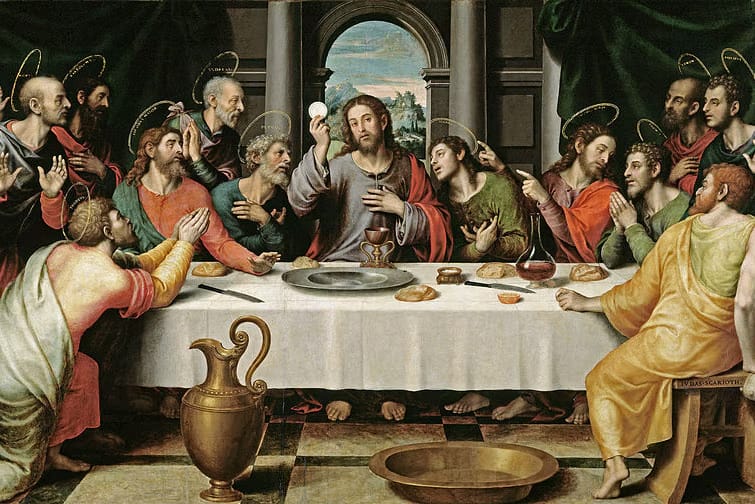
Like many other theologians, he wrote extensive commentaries on the Bible available for the faithful to read.
Unlike other theologians, he got special help from very special people to aid in the accuracy of his commentaries.
Legend has it that one of his fellow Dominican friars, known as Friar Reginald, would hear voices speaking to Aquinas in his solitary cell. This was particularly unusual because visitors are not typically allowed in the cells, especially for long periods of time. After this happened on several occasions, Reginald confronted Aquinas to ensure he wasn’t breaking the strict enclosure rules.
Aquinas then told him that he was speaking to Sts. Peter and Paul, asking them questions to verify that his interpretations of their epistles were accurate.

st. peter and st. aquinas
The story that best depicts the life of St. Thomas Aquinas is when the Lord spoke to Aquinas towards the end of his life through a crucifix.
Christ said to him: “Well you have written of me Thomas…what would you like in return?”
Aquinas replied, “Non nisi te Domine.”
“Nothing but thyself, O Lord.”
This perfectly highlights Aquinas’s mission: to use his other-worldly intellect to deepen his knowledge of the faith, with not the knowledge itself being the ends, but as a means to deepen his relationship with God.
We see in today’s online discussions of Catholicism an endless back and forth on the various theological topics, which is undeniably a beautiful sight. We should want to spread our faith to the ends of the Earth and peacefully convert as many people as possible. But what can’t be forgotten is that knowledge and practice of the faith must work together in the same way faith and reason do. For what good is it to know that Peter’s office holds a special primacy or Revelation 11-12 depicts Mary’s Bodily Assumption if we aren’t charitable to our neighbors and don’t spend time alone in prayer with God?
Aquinas understood perfectly that a deep knowledge of the faith would help him grow closer to God and that’s the reason why composed the work he did.
Let us continue to grow in holiness and mimic Aquinas’s wisdom, purity, and chastity as we contemplate the celebration of his feast day earlier this week.
If you enjoyed this article, feel free to share with your family, co-workers, and friends and tell them to subscribe.
Thanks for reading and until next time.
Reply